


Forvis Mazars reveals Thailand’s mergers and acquisitions (M&A) market remains attractive and continues to draw investment inflows, yet deal completion rates in the first eight months of 2026 plunged to 46% due to a 5x valuation gap between buyers and sellers; advises investors to elevate due diligence and implement rigorous contract structuring from the outset.
Although Thailand continues to attract sustained interest from both domestic and international investors, a substantial gap between announced mergers and acquisitions (M&A) deals and completed transactions underscores the growing importance of early-stage regulatory assessments, thorough due diligence, and strategic deal structuring, according to the latest analysis from Forvis Mazars in Thailand.
Data from S&P Capital IQ and analysis by Forvis Mazars indicate that between January and August 2026, a total of 132 M&A transactions were announced in Thailand with an aggregate value of approximately THB 117.2 billion. However, only 61 deals reached completion during the same period (valued at roughly THB 78.5 billion), translating to a deal completion rate of approximately 46%—a decline from the 2021–2025 average of around 67%.
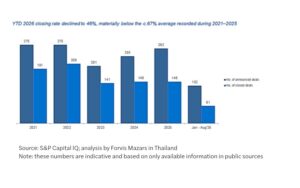
The analysis, led by Prasenjit Chakraborty, Financial Advisory Partner at Forvis Mazars in Thailand, also highlights a pronounced valuation gap between announced and completed transactions. Between January and August 2026, the average EV/EBITDA multiple for announced deals stood at approximately 20.0x, whereas the multiple for completed deals was 15.0x.
‘This data should not be interpreted to mean that every transaction is discounted by 5x EBITDA, as such differentials may be influenced by other variables including business type, sector, and deal size. Nevertheless, the figures point to a recurring friction point during M&A negotiations,’ said Prasenjit. ‘Valuation gaps typically arise because sellers tend to emphasise growth potential, customer relationships, and synergy opportunities, whereas buyers place greater weight on earnings sustainability, cash flows, and identifiable risks.’

Navigating interconnected transaction risks and incentives, Thailand’s strategic geographical location, robust manufacturing base, and incentives from the Thailand Board of Investment (BOI) continue to drive M&A opportunities across the mid-market segment—spanning packaging, consumer goods, energy, manufacturing, financial services, and healthcare—alongside large-scale telecommunications and infrastructure transactions.
However, Forvis Mazars observes that cross-border investors frequently encounter delays or aborted negotiations due to interconnected risks across four core areas:
- Regulatory and ownership: Navigating the Foreign Business Act, sector-specific operating licences, and BOI eligibility criteria. As Prasenjit noted, operating within a promoted industry does not automatically guarantee BOI tax exemptions unless specific conditions and approvals are satisfied.
- Commercial and contractual: Assessing customer concentration and change-of-control provisions within material contracts.
- Financial and operational: Scrutinising sustainable cash flows, particularly within privately held or family-owned businesses where working capital, capital expenditure (CapEx), and shareholder loans significantly impact valuation.
- Tax and structuring: Evaluating corporate income tax (20%), dividend withholding tax (10%), transfer pricing, and the optimal market-entry vehicle (such as a Thai limited company versus a BOI-promoted entity) to safeguard post-tax returns at the shareholder level.

To bridge the gap between deal announcements and successful completions, Forvis Mazars recommends translating due diligence findings into protective mechanisms within the Sale and Purchase Agreement (SPA). These include treating shareholder loans as debt-like items, adjusting enterprise valuations to account for unspent capital expenditure (CapEx), and establishing clear tax indemnities or conditions precedent.
Prasenjit further advised: ‘Prior to proceeding with an acquisition in Thailand, investors should consider three pivotal questions. First, is the proposed investment structure both legally viable and commercially sound, accounting for foreign shareholding restrictions, BOI incentives, taxation, and operational requirements?
‘Second, can the business generate sustainable cash flows, factoring in working capital, capital expenditure, related-party transactions, and potential tax liabilities? Third, have the risks identified during the transaction been appropriately reflected in the valuation and contractual documentation so that investors secure adequate protection and possess a clear understanding of their post-acquisition obligations?’
Addressing these factors early enables investors to mitigate value erosion, prevent unnecessary delays, and achieve sustainable long-term returns amidst Thailand’s continuously evolving investment landscape.
About Forvis Mazars in Thailand
Forvis Mazars redefines collaboration, provides the insight to help clients prepare for what’s next by combining global reach with deep local expertise. Forvis Mazars operates in over 100 countries and territories worldwide. In Thailand, we provide outsourcing, audit and assurance, tax, legal, and financial advisory services. Backed by over 400 professionals and a diverse, multinational team, we are uniquely positioned to serve as a bridge between businesses operating in Thailand and international partners. Our teams blend global expertise with deep local understanding to support clients at every stage of their business growth.